


Social proof is one of the most well-documented conversion tools in digital marketing. But the term covers two fundamentally different approaches — and the distinction matters far more than most marketers realise.
On one side are FOMO (fear of missing out) notifications: the popup alerts that flash across websites announcing “Sarah from London just purchased Product X” or “23 people are viewing this page right now.” These create urgency through implied scarcity and social pressure.
On the other side are trust-based signals: star ratings, customer counts, avatar displays, trust badges, and testimonials that communicate credibility through implied popularity and peer validation. These build confidence rather than urgency.
Both approaches claim to increase conversions. Both are widely used. But the academic and industry research tells a more nuanced story — one that suggests these two approaches are not equally effective, and that in some cases, FOMO tactics can actually undermine the very trust they are trying to build.
This article examines the evidence behind both approaches and asks a straightforward question: which type of social proof actually works?
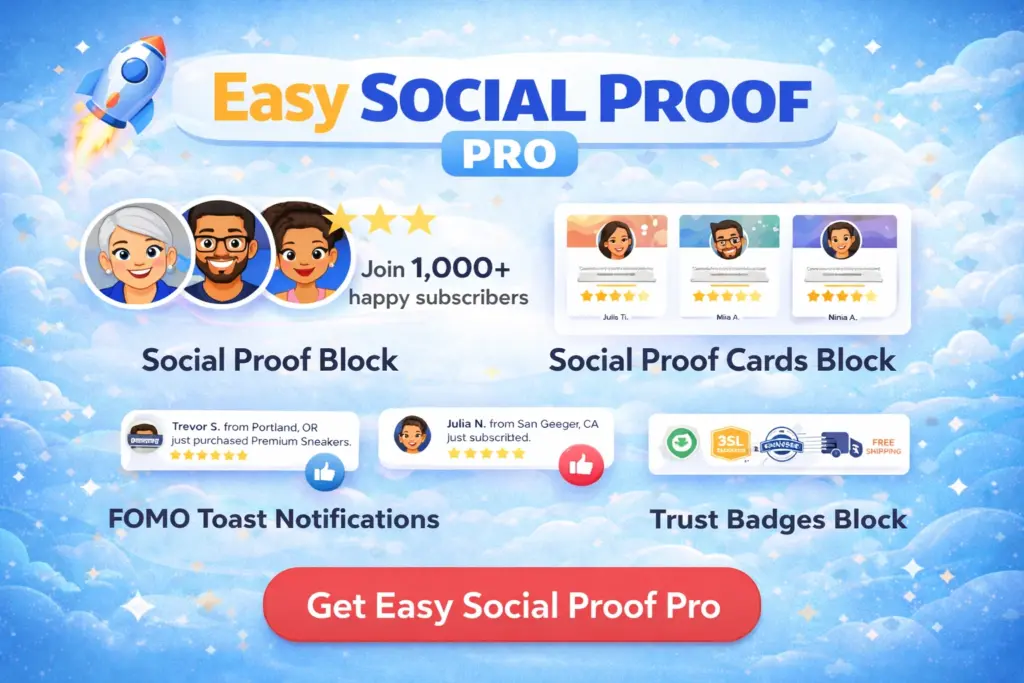
Get our FREE compact Easy Socialal Proof Lite WordPress plugin designed using the latest research
The Theory Behind FOMO
The psychological basis for FOMO notifications draws on two established principles: scarcity and social influence.
Scarcity, as identified by Robert Cialdini in his foundational work Influence: The Psychology of Persuasion (1984), describes the tendency for people to assign greater value to things that are perceived as limited or diminishing. When a notification tells you that stock is running low or that dozens of people are buying right now, it activates the scarcity heuristic — the feeling that if you do not act quickly, you will miss out.
The social influence component operates through what psychologists call descriptive norms — the observation of what other people are doing. When you see that “John from Manchester just bought this item,” the implicit message is that other people like you are making this purchase, which normalises the behaviour and reduces hesitation.
In theory, the combination of scarcity and descriptive norms should be powerfully persuasive. The consumer sees both that others are buying (social validation) and that the opportunity may be fleeting (urgency). This is why FOMO notifications became enormously popular in eCommerce from around 2017 onwards, spawning an entire category of SaaS tools and WordPress plugins.
Reference: Cialdini, R. B. (1984). Influence: The Psychology of Persuasion. New York: William Morrow.
The Theory Behind Trust-Based Social Proof
Trust-based social proof operates through different psychological mechanisms — primarily informational social influence and the bandwagon effect.
Informational social influence describes the tendency to use the behaviour of others as a source of information when making decisions under uncertainty. A star rating of 4.7 from 2,000 reviews provides a powerful informational signal: the aggregate opinion of thousands of previous buyers serves as a reliable quality indicator without requiring the consumer to evaluate the product independently.
The bandwagon effect describes the tendency to adopt behaviours because others are doing so. Customer counts (“Trusted by 10,000+ businesses”) and visual popularity indicators (overlapping customer avatars) trigger this effect by communicating that the majority has already made this choice. The prospective customer’s internal question shifts from “Should I buy this?” to “Why haven’t I bought this yet?”
Critically, trust-based social proof does not depend on urgency. It does not ask the consumer to act now or lose the opportunity. Instead, it builds a cumulative case for credibility that makes the purchase feel safe rather than urgent. The consumer buys not because they fear missing out, but because the evidence suggests they are making a good decision.
References:
- Roethke, K., Klumpe, J., Adam, M., & Benlian, A. (2020). Social influence tactics in e-commerce onboarding: The role of social proof and reciprocity in affecting user registrations. Decision Support Systems, 131, 113268.
- Amblee, N., & Bui, T. (2011). Harnessing the influence of social proof in online shopping: The effect of electronic word of mouth on sales of digital microproducts. International Journal of Electronic Commerce, 16(2), 91–114.
What the Research Says About FOMO Notifications
The Park and McCallister Study
The most direct academic examination of FOMO-style notifications comes from Park and McCallister’s 2023 study published in the Journal of Student Research. The researchers investigated how different social proof tactics — specifically product reviews and pop-up notifications showing other buyers’ activity — affected consumer purchase likelihood.
The findings were striking. Positive product reviews significantly increased purchase likelihood among participants. However, pop-up notifications showing other buyers’ purchasing activity had little to no additional effect on purchase decisions. More notably, when pop-up notifications were combined with reviews, the combined effect was not additive. In some conditions, the notifications actually reduced the impact of the reviews.
The researchers suggested that the notifications may have created a distraction effect — drawing attention away from the substantive trust signal (the review) and towards a less persuasive signal (the popup). Rather than reinforcing the consumer’s confidence, the notification introduced noise into the decision-making process.
This is a significant finding because the prevailing assumption in eCommerce marketing has been that layering multiple social proof types produces cumulative benefits. The Park and McCallister research suggests that this is not always the case, and that some combinations can be counterproductive.
Reference: Park, S., & McCallister, J. (2023). The Effects of Social Proof Marketing Tactics on Nudging Consumer Purchase. Journal of Student Research, 12(3).
The Reactance Problem
Beyond the specific findings of individual studies, there is a well-established body of psychological research on reactance — the tendency for people to resist persuasion attempts that they perceive as manipulative or coercive. When consumers feel that a marketing tactic is designed to pressure them into a decision, they often respond by doing the opposite of what the marketer intended.
Brehm’s theory of psychological reactance (1966) established that when people perceive a threat to their freedom of choice, they experience a motivational state that drives them to reassert that freedom — often by rejecting the very option being promoted. In the context of FOMO notifications, this means that consumers who recognise the tactic as a deliberate pressure mechanism may become less likely to purchase, not more.
This effect is particularly pronounced among younger consumers. PowerReviews’ research found that 53% of Gen Z shoppers actively distrust perfect 5-star ratings, indicating a generation that is highly attuned to marketing manipulation. The same scepticism extends to FOMO tactics. Trustpilot’s 2023 consumer study found that younger demographics, while more responsive to genuine social proof (star ratings, reviews, testimonials), were also more likely to view aggressive urgency tactics with suspicion rather than persuasion.
The reactance problem is compounded by the proliferation of FOMO tools. When dozens of websites use identical notification popups with the same format and animation style, consumers learn to recognise the pattern. What was once a novel and attention-grabbing signal becomes a recognised marketing tactic — and recognition breeds scepticism.
References:
- Brehm, J. W. (1966). A Theory of Psychological Reactance. New York: Academic Press.
- PowerReviews (2022). Ratings & Reviews Benchmarks: Average Rating Impact on Conversion.
- Trustpilot (2023). The Psychology Behind Trust Signals: Why and How Social Proof Influences Consumers.
The Credibility Gap on Smaller Sites
FOMO notifications face an inherent credibility challenge that trust-based signals do not. For a real-time purchase notification to be effective, the consumer must believe that it represents genuine activity. On a high-traffic eCommerce site with thousands of daily transactions, this is plausible. On a smaller site, the notifications can appear obviously manufactured.
Consider a niche online store that receives 50 visitors per day. If that store displays notifications claiming “Someone just purchased this item” every 30 seconds, even a casual observer will recognise that the activity does not match the site’s apparent scale. The notification, intended to build trust, instead signals inauthenticity — which is the opposite of trust.
This problem does not apply to trust-based social proof. A small business that displays “Trusted by 500+ customers” with a 4.8-star rating is making a static claim that can be presented credibly at any scale. The visitor cannot cross-reference the claim against real-time traffic patterns because the signal is not tied to live activity. It functions as a brand statement rather than a data feed, and brand statements are evaluated on their face rather than verified against observable behaviour.
The credibility gap becomes even more pronounced when FOMO notifications display personal information. Messages like “Sarah from Birmingham just purchased…” raise immediate questions about data privacy. In a post-GDPR environment, consumers are increasingly uncomfortable with the idea that their purchasing behaviour is being broadcast to other visitors in real time. Even when the data is anonymised or generated from aggregate activity rather than individual transactions, the format implies personal data exposure — which can trigger privacy concerns rather than purchase confidence.
The Fatigue Effect
Research on banner blindness — the well-documented phenomenon where website visitors unconsciously ignore banner-like information — suggests that recurring, predictable visual elements on websites lose their impact over time. Nielsen Norman Group’s eye-tracking studies have consistently shown that users develop rapid habituation to repetitive visual patterns, particularly those that resemble advertising.
FOMO notifications, by their nature, are repetitive. They appear at regular intervals, in consistent locations, with predictable formatting. Over the course of a browsing session, each successive notification carries less impact than the last. By the third or fourth popup, many visitors have mentally filtered them out entirely — or worse, developed active irritation.
Static trust signals do not suffer from the same fatigue effect because they are not interruptions. A star rating, an avatar stack, or a trust badge sits within the page design as a persistent element rather than demanding attention through animation and movement. The visitor processes these signals as part of the page content rather than as advertising overlay, which means they bypass the mental filters that block interruptive elements.
Reference: Nielsen Norman Group (2018). Banner Blindness Revisited: Users Dodge Ads on Mobile and Desktop.
What the Research Says About Trust-Based Social Proof
The evidence for trust-based social proof — star ratings, review counts, customer numbers, and visual trust signals — is substantially stronger and more consistent than the evidence for FOMO notifications.
Star Ratings and Reviews
The Spiegel Research Center at Northwestern University found that displaying reviews increased conversion rates by up to 270% when five or more reviews were present. This remains the most widely cited figure in the social proof literature, and it has been supported by numerous subsequent studies across different industries and contexts.
PowerReviews’ analysis of 20 million product pages found that even passive exposure to reviews lifted conversion by approximately 20%, with the effect increasing dramatically when consumers actively engaged with review content. Consumers who filtered reviews by star rating converted at 111.8% above the average visitor rate. Those who used review search functionality converted at 202.9% above average.
Critically, these effects were consistent across business sizes, product categories, and traffic levels. Unlike FOMO notifications, which depend on having sufficient transaction volume to appear credible, star ratings and review displays work for businesses at any scale.
References:
- Spiegel Research Center (2017). How Online Reviews Influence Sales. Northwestern University.
- PowerReviews (2022). Ratings & Reviews Benchmarks: Average Rating Impact on Conversion.
Visual Trust Signals
Trustpilot’s large-scale consumer study of 1,697 respondents found that star ratings on the homepage were the most effective social proof placement, influencing 86% of consumers. Star ratings on product pages influenced 85%, and even on checkout pages the figure was 78%.
The study also found that the effect of visual trust signals was remarkably consistent across age groups and geographies. While younger consumers were slightly more responsive (72% of Gen Z versus 63% of baby boomers), the baseline effectiveness was high across all demographics.
This consistency is a significant advantage over FOMO notifications, whose effectiveness appears to vary much more widely depending on context, audience, and implementation quality.
Reference: Trustpilot (2023). The Psychology Behind Trust Signals: Why and How Social Proof Influences Consumers.
Trust Badges and Security Signals
The Baymard Institute’s research on cart abandonment found that 19% of consumers abandon purchases because they do not trust the site with their credit card information. Trust badges — SSL indicators, money-back guarantee badges, secure payment icons — directly address this anxiety.
Trust badges function as a specific category of trust-based social proof. They do not create urgency or exploit FOMO. Instead, they reduce the perceived risk of a transaction by associating the site with recognised security standards and guarantees. Their effectiveness is well-documented: multiple conversion rate optimisation studies have found that adding trust badges near checkout forms reduces cart abandonment by measurable margins.
The mechanism is purely trust-based. The consumer sees the badge, associates it with security, and feels more confident proceeding. There is no urgency component, no fear of missing out, and no social pressure — just a straightforward reduction in perceived risk.
Reference: Baymard Institute (2024). Cart Abandonment Rate Statistics.
The Scale Problem: Why FOMO Fails for Most Sites
One of the most significant practical differences between FOMO notifications and trust-based signals is their dependency on traffic and transaction volume.
FOMO notifications are, by definition, a reflection of real-time activity. They claim to show what is happening on a site right now. This creates a minimum viability threshold: the site must have enough genuine activity to make the notifications believable. For large eCommerce platforms processing hundreds or thousands of orders per day, this threshold is easily met. For the vast majority of websites — small businesses, freelancers, startups, niche stores, bloggers, membership sites — it is not.
The Baymard Institute’s research indicates that the median eCommerce conversion rate sits between 2% and 3%. For a site receiving 100 visitors per day with a 2.5% conversion rate, that translates to approximately 2.5 purchases per day — roughly one purchase every 10 hours. A FOMO notification system on such a site would either display notifications so infrequently as to be invisible, or recycle old transactions so aggressively that the “real-time” claim becomes transparently false.
Trust-based social proof has no such dependency. A star rating, a customer count, an avatar stack, or a trust badge communicates credibility regardless of what is happening on the site at that moment. A site with 10 visitors per day and a site with 10,000 visitors per day can both display “Trusted by 500+ customers” with equal credibility, because the claim is cumulative rather than instantaneous.
This scale independence makes trust-based social proof the more practical choice for the majority of websites, which do not have the traffic volumes to sustain credible real-time notifications.
The Mobile Dimension
Mobile devices account for approximately 70% of all retail eCommerce traffic globally, yet mobile conversion rates consistently lag behind desktop. Cart abandonment rates on mobile (73–75%) are significantly higher than on desktop (65–68%). This gap is driven in part by the constraints of smaller screens — less space to display information, shorter attention spans, and greater sensitivity to interruptive elements.
FOMO notification popups are particularly problematic on mobile. They consume a disproportionate share of screen real estate, can obscure important page elements (including the checkout button they are supposed to encourage visitors to click), and their animated appearance can cause layout shifts that degrade the browsing experience. Google’s Core Web Vitals framework specifically penalises unexpected layout shifts, meaning that poorly implemented notification popups can also damage a site’s search engine rankings.
Trust-based signals are inherently better suited to mobile. A compact visual element — an avatar stack with a star rating and a short trust message — communicates social proof in a single glance without consuming significant screen space, without causing layout shifts, and without interrupting the browsing experience. The information is processed passively as part of the page content rather than requiring active attention and dismissal.
When FOMO Notifications Do Work
The evidence against FOMO notifications is not absolute. There are specific contexts where urgency-based social proof can be effective.
High-traffic eCommerce sites with genuine, verifiable transaction volumes can use FOMO notifications credibly. When a site genuinely processes dozens of orders per hour, real-time notifications reflect reality rather than manufacturing it.
Limited-time promotions and flash sales create natural urgency that FOMO notifications can amplify. In these contexts, the urgency is genuine rather than manufactured, which reduces the reactance effect.
Event-based and ticket sales where inventory is genuinely finite benefit from scarcity signals. “Only 12 seats remaining” is a factual statement in the context of a specific event, not a psychological manipulation.
However, even in these favourable contexts, the Park and McCallister research suggests that FOMO notifications should complement rather than replace trust-based signals — and that combining the two requires care to avoid the distraction effect observed in their study.
The Evidence-Based Approach
The research points clearly towards a hierarchy of effectiveness in social proof implementation.
First priority: trust-based signals. Star ratings, customer counts, visual trust elements (avatar stacks, trust badges), and review displays have the strongest, most consistent evidence base. They work across all business sizes, traffic levels, and demographics. They do not depend on real-time data, do not raise privacy concerns, and do not trigger reactance. The Trustpilot consumer study found that star ratings on the homepage influenced 86% of consumers — the highest effectiveness figure reported for any social proof placement or type.
Second priority: written reviews and testimonials. These provide the depth and specificity that visual trust signals cannot. The Spiegel Research Center’s 270% conversion increase was driven primarily by written reviews. Reviews are most effective on product pages and near decision points where consumers are evaluating specific options.
Third priority: FOMO notifications — but only where appropriate. Sites with genuine high-volume activity can layer FOMO notifications on top of trust-based signals, but should do so carefully. The Park and McCallister finding that notifications can reduce the effectiveness of reviews when combined suggests that implementation matters as much as the decision to use them.
Avoid FOMO notifications when: the site has low traffic or low transaction volume, the target audience skews younger and more scepticism-prone, the site handles sensitive purchases where trust is paramount, or the notifications would display personal information in a way that raises privacy concerns.
Conclusion
The question posed by this article — which type of social proof actually works? — has a clear answer supported by the evidence.
Trust-based social proof works reliably, consistently, and at any scale. The research behind star ratings, review displays, customer counts, and visual trust signals is extensive, well-replicated, and shows strong effects across industries, demographics, and contexts.
FOMO notifications work in specific, favourable conditions — primarily high-traffic eCommerce environments with genuine transaction volumes — but the evidence for their effectiveness is weaker, more context-dependent, and complicated by documented problems including reactance, credibility gaps, notification fatigue, and privacy concerns. The Park and McCallister study’s finding that FOMO popups can actually reduce the effectiveness of reviews when the two are combined is particularly significant, as it challenges the assumption that more social proof is always better.
For the majority of websites — which do not operate at the scale of Amazon or ASOS — the evidence strongly favours a trust-first approach. Build credibility through star ratings, customer counts, visual trust signals, and reviews. These elements work from day one, require no ongoing transaction data, respect visitor privacy, and have the strongest documented impact on conversion rates.
Urgency has its place. But trust comes first.
References
Amblee, N., & Bui, T. (2011). Harnessing the influence of social proof in online shopping: The effect of electronic word of mouth on sales of digital microproducts. International Journal of Electronic Commerce, 16(2), 91–114.
Baymard Institute (2024). Cart Abandonment Rate Statistics.
Brehm, J. W. (1966). A Theory of Psychological Reactance. New York: Academic Press.
Cialdini, R. B. (1984). Influence: The Psychology of Persuasion. New York: William Morrow.
Nielsen Norman Group (2018). Banner Blindness Revisited: Users Dodge Ads on Mobile and Desktop.
Park, S., & McCallister, J. (2023). The Effects of Social Proof Marketing Tactics on Nudging Consumer Purchase. Journal of Student Research, 12(3).
PowerReviews (2022). Ratings & Reviews Benchmarks: Average Rating Impact on Conversion.
Roethke, K., Klumpe, J., Adam, M., & Benlian, A. (2020). Social influence tactics in e-commerce onboarding: The role of social proof and reciprocity in affecting user registrations. Decision Support Systems, 131, 113268.
Spiegel Research Center (2017). How Online Reviews Influence Sales. Northwestern University.
Trustpilot (2023). The Psychology Behind Trust Signals: Why and How Social Proof Influences Consumers.
If you’re ready to put this research into practice, our Best Social Proof Plugins for WordPress (2026) — The Complete Guide covers the best tools for adding trust signals to your site.