

If you have spent any time reading marketing blogs, you have seen the claims. “Social proof increases conversions by 400%!” “Add this one widget and watch your sales explode!” The numbers get bigger with every article, and the line between evidence and sales pitch gets thinner.
So let us cut through the noise. Does social proof actually increase conversions? And if so, by how much — based on real research, not marketing copy?
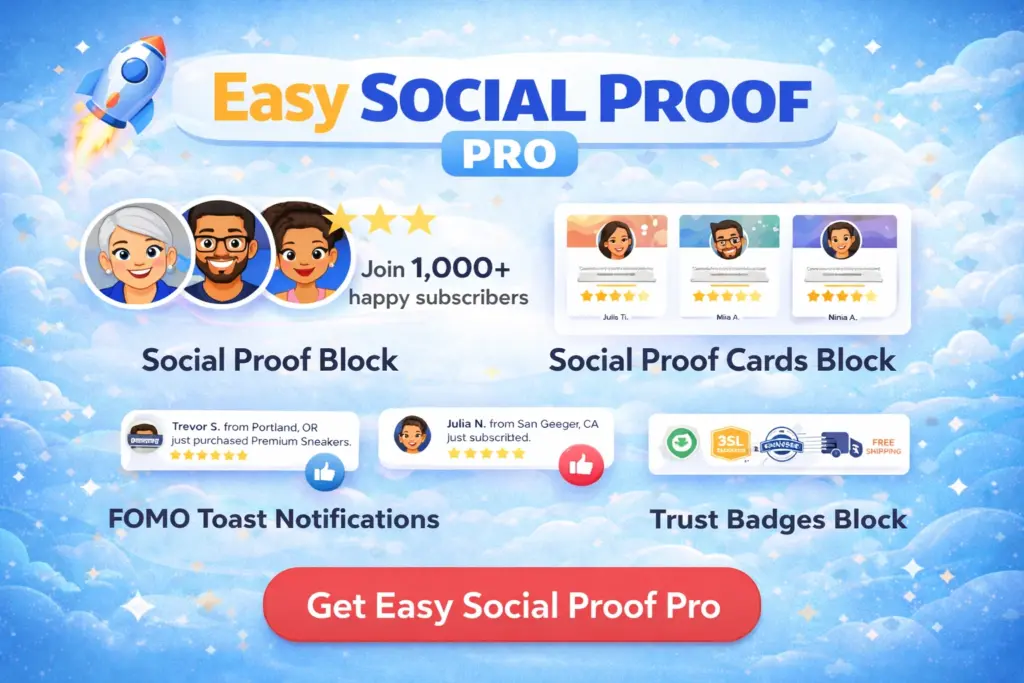
Get our FREE compact Easy Socialal Proof Lite WordPress plugin designed using the latest research
What the Studies Actually Found
The most rigorous research on this question comes from the Spiegel Research Center at Northwestern University. Their study analysed data from two online retailers, covering more than 100,000 products and 15 million page views over the course of a year.
The headline finding: displaying reviews increased conversion rates by an average of 270% when five or more reviews were present. That is a real, substantial number from a credible academic source. But it needs context.
First, the 270% figure represents the difference between products with reviews and products with no reviews at all. It is not the difference between having social proof and having slightly different social proof. If your site already displays reviews and you add an avatar stack, you should not expect a 270% lift on top of what you already have.
Second, the effect varied dramatically by price point. Lower-priced products saw a 190% conversion increase. Higher-priced products saw 380%. This makes intuitive sense — the more expensive the purchase, the more uncertainty the buyer feels, and the more they rely on others’ experiences to reduce that uncertainty.
Third, the effect was non-linear with respect to star ratings. Conversion rates peaked in the 4.0–4.7 range and actually declined as ratings approached 5.0. Perfect scores trigger suspicion, not confidence.
Beyond the Northwestern Study
Other research supports the general finding but with more moderate numbers.
Bazaarvoice found that products with reviews had a 12.5% higher conversion rate than products without — a meaningful but far more modest figure than the Spiegel Center’s headline number. PowerReviews’ analysis of 20 million product pages found that simply seeing reviews lifted conversion by approximately 20%, with the effect increasing substantially when consumers actively engaged with the review content.
Trustpilot’s consumer study of 1,697 respondents found that 66% said the presence of a social proof widget increased their likelihood to purchase, and that star ratings on the homepage influenced 86% of consumers.
Uberall’s study of 64,000 business listings found that an increase of just 0.1 stars in average rating could boost conversions by up to 25%.
The pattern across all these studies is consistent: social proof has a real, measurable positive effect on conversions. The exact magnitude varies by context — product type, price point, audience, placement, and the specific form of social proof used.
What Does Not Work as Well as Claimed
Not every form of social proof performs equally.
FOMO notification popups — the “Sarah just purchased this item” alerts — have weaker evidence behind them than their popularity would suggest. Park and McCallister’s 2023 study found that these notifications had little to no additional effect on purchase likelihood. In some conditions, they actually reduced the positive impact of reviews when the two were combined on the same page.
This does not mean FOMO popup notifications never work. It means the evidence is more mixed and context-dependent than the FOMO marketing materials from FOMO plugin companies would have you believe. High-traffic eCommerce stores with genuine transaction volumes may see benefits. Smaller sites are less likely to.
The Honest Answer
Does social proof increase conversions? Yes, consistently and measurably. The evidence across multiple independent studies, methodologies, and contexts is clear on this point.
But the size of the effect depends on several factors:
What you are starting from. Going from zero social proof to basic trust signals (star ratings, customer counts) produces the largest jump. Adding additional layers on top of an existing social proof strategy produces smaller incremental gains.
What type of social proof you use. Star ratings and written reviews have the strongest, most consistent evidence. Visual trust signals (avatars, trust badges) are effective for first impressions. FOMO notifications have mixed evidence and work only in specific contexts or with other .
Where to place social proof. Homepage placement influences the most consumers (86% according to Trustpilot). Product pages are nearly as effective (85%). Even checkout pages benefit (78%). Social proof buried in a footer or on a dedicated testimonials page that nobody visits has minimal impact.
How credible it is. Authentic, specific social proof outperforms vague or inflated claims. A 4.7-star rating with genuine mixed reviews is more persuasive than a perfect 5.0. “Trusted by 2,347 customers” is more believable than “trusted by thousands.”
The Practical Takeaway
If your website currently displays no social proof, adding even basic trust signals — a star rating, a customer count, a few avatar images — will almost certainly improve your conversion rate. The research supports this with a high degree of confidence.
If your site already has reviews and ratings, the gains from additional social proof elements will be real but more modest. Focus on placement (above the fold, near calls to action) and credibility (specific numbers, real testimonials) rather than simply adding more.
And be sceptical of any tool or plugin that promises specific conversion increases. The research shows that social proof works. It does not show that any single product will deliver a guaranteed percentage lift, because the effect depends on your specific context. Ecommerce social proof research backs this up.
Get our free social proof plugin for wordpress at the wordpress plugin derectory: Easy Social Proof Lite.
For a full breakdown of the research, read Do Star Ratings Really Increase Conversions? What the Research Says.
For a comparison of the tools available, see our Best Social Proof Plugins for WordPress (2026) — The Complete Guide.